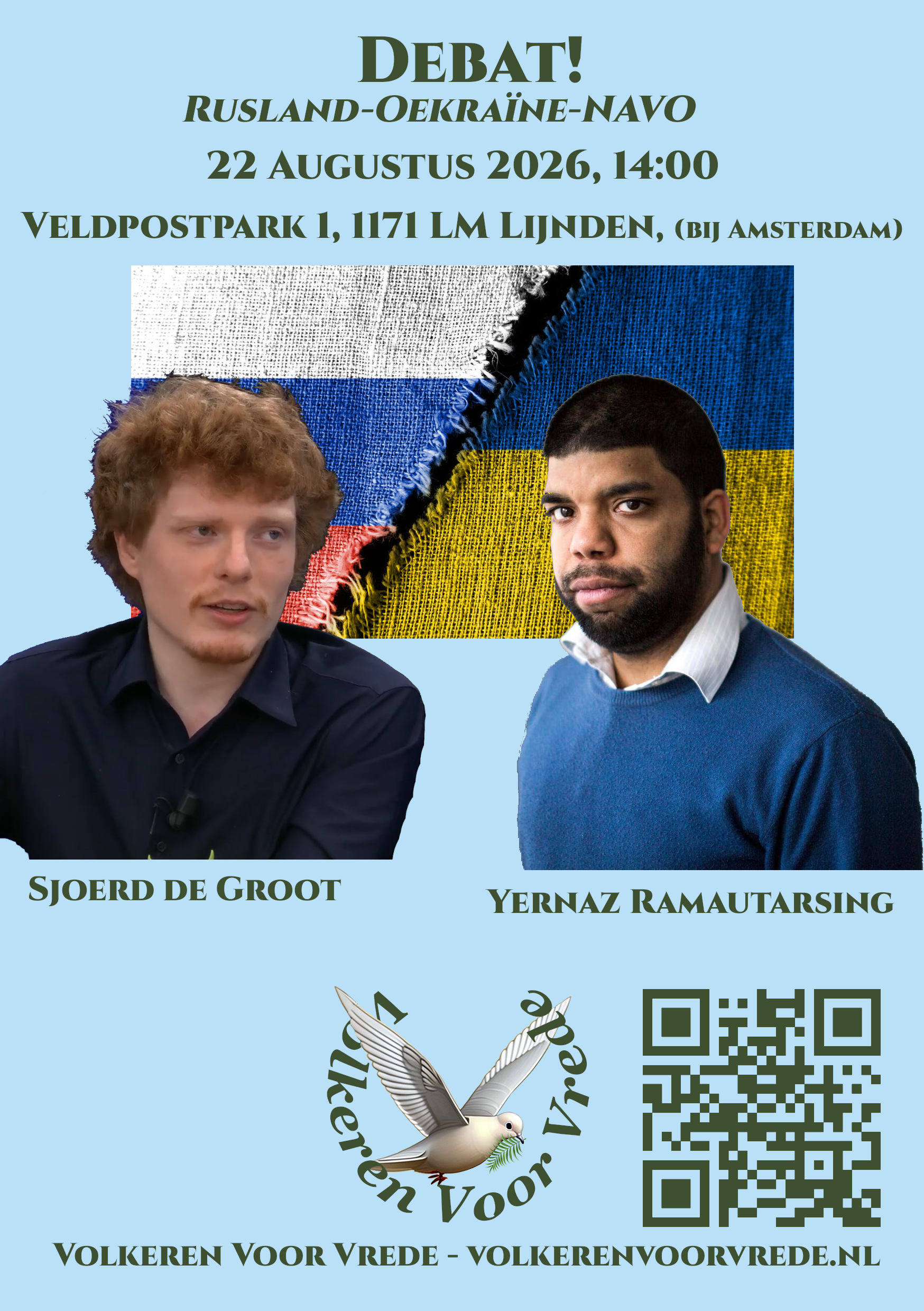
Op zaterdag 22 augustus, om 14:00 organiseert Volkeren Voor Vrede een debat over de oorlog in Oekraïne tussen Yernaz Ramautarsing en Sjoerd de Groot namens Volkeren Voor Vrede. In dit debat zal de achtergrond, grondoorzaken en de geopolitieke dynamiek aan bod komen.
Dit debat zal een unieke uitwisseling zijn tussen het radicale pro-NAVO en het radicale anti-NAVO kamp, twee delen van de discussie die doorgaans alleen over elkaar, niet met elkaar spreken.
Het debat zal worden gemodereerd door Marco van Duijn – bekend van het kanaal Recht Voor Allen en Café de Utopie.
Historicus Ton Munnich schreef onlangs op zijn website tonmunnich.com een artikel met een voorstel over internationale vrede en de rol van Oekraïne hierin. Wij kregen toestemming dit interessante artikel ook op onze website te plaatsen.
THE FUTURE OF KYIV Some Thoughts on the United Nations
Introduction For more than a century now the countries of the world have been organized in a global structure. First in the League of Nations, founded in 1919 and seated in the city of Geneva in neutral Switzerland. And then in the United Nations, founded 1945 and seated in New York.
In the half century before the First World War there had been persons and organizations in Europe with an interest in settling international conflicts by other means than war. For instance French politician Léon Bourgeois should be mentioned in this respect. And Bertha von Suttner, Leo Tolstoi, Alfred Nobel and others. As should be mentioned the international Peace Conferences of 1899 and 1907 in The Hague, and the opening of the Peace Palace in The Hague in 1913. The Peace Palace today still is the seat of the Permanent Court of Arbitration and the International Court of Justice.
Despite these peace initiatives the First World War broke out, an unprecedented maelstrom of destruction and bloodshed. It showed the urgency to set up an international mechanism to avoid such explosions of violence. In January 1919 the Paris Peace Conference started, in June it produced the Treaty of Versailles. An important part of the Treaty was the founding of the League of Nations. This organization, in the tradition of the pre-war peace initiatives, mainly was meant to settle international conflicts by political and legal procedures, all meant to avoid war.
First attempt: The League of Nations The Paris Peace Conference worked in several commissions. One of these was the ‘League of Nations Commission’, chairman of which was American President Woodrow Wilson. He presented a list of 14 points, one of which was this:
“A general association of nations must be formed under specific covenants for the purpose of affording mutual guarantees of political independence and territorial integrity to great and small states alike”
Nothing new, these ideas had circulated in Europe for half a century by then. But public opinion in the United States gave Woodrow Wilson’s sentence much credit for the realization of the League of Nations. In reality Woodrow Wilson’s contribution in Paris was not that impressive.
In the ‘League of Nations Commission’ in Paris the Japanese delegation submitted the “Proposal to abolish racial discrimination”. Japan wanted a “Racial Equality Clause” added to the Covenant of the League. The majority of the delegations voted in favor of the addition and no one voted against it. But the US and the UK (who were against) abstained from voting, after which chairman Woodrow Wilson dismissed the voting result, now saying that it required unanimity. The British and Americans maneuvered the proposal from the table, thus causing a bad start for the League of Nations.
This display of Anglo-American racism, and of Woodrow Wilson’s racism in particular, represented the ideas about Galtonian eugenics and Nordic race superiority that ruled the United States at the time. During the 20th century Anglo-American historians condoned Woodrow Wilson’s views, but in the 21st century public opinion changed. In 2020 Princeton University, of which he had been President (1902-1910), removed his name from institutions that had been named after him. President C.L. Eisgruber of Princeton in 2020 motivated this step by saying:
“Woodrow Wilson’s racist thinking and policies make him an inappropriate namesake for a school or college […] Wilson’s racism was significant and consequential even by the standards of his own time.”
Another fact qualified Woodrow Wilson’s contribution in Paris too. His country, the US, refused to ratify the Treaty of Versailles and refused to become a member of the League of Nations. Why? The preamble of the League’s Covenant expected its members “not to resort to war”. To that aim its paragraphs stated:
“… the maintenance of peace requires the reduction of national armaments …”.
Followed by:
“The Council […] shall formulate plans for such reduction …”.
And this:
“the manufacture by private enterprise of munitions and implements of war is open to grave objections”.
The US did not want its hands tied by these paragraphs. The foreign policy of the US had two main principles: the Monroe Doctrine and the Roosevelt Corollary. These two principles demanded that the European colonial empires should stay away from the American continent and that the US had the right to intervene in all countries of Latin America. Which it frequently did. A League-membership would have hampered these neo-colonial activities.
All in all the US was not interested in the League of Nations.
Second attempt: The United Nations After the Second World War the League was dissolved, a new organization was founded: the United Nations (1945). This time the US did become a member, it even became its host country, New York became the seat of the UN headquarters.
As a host for the UN the US has some obligations which are laid out in the UN Headquarters Agreement of 1947. The document, signed by US and UN, has 28 sections, of which sections 11 and 12 are of interest here. Section 11 ordains:
“the United States shall not impose any impediments to transit to or from the headquarters district” for diplomats, experts and journalists who are accredited by the UN.
Section 12 specifies:
“The provisions of Section 11 shall be applicable irrespective of the relations existing between the Governments of the persons referred to in that section and the United States.”
Despite this written and signed agreement the US does deny visa to government representatives of unloved countries, thus obstructing their participation in UN organizations. In recent years Iran and the Russian Federation have been the target of this. For instance, on 26 May 2026 Russia’s representative to the UN, Vassily Nebenzia, opened his contribution to a meeting of the UN Security Council with the following words:
“the Russian delegation should have been represented at this meeting by the Deputy Foreign Minister Alexander Alimov […] However, despite all our efforts to secure a visa for him from the US side, that visa was never granted. We view this […] as a breach by Washington of its obligations under the Headquarters Agreement, which stipulates that access to the UN headquarters must be granted to all officials of Member States”.
Apparently the US has difficulty to uphold its duties as host country of the UN.
Generally speaking the US is an uneasy place for the UN headquarters, due to the geopolitical situation. Soon after the founding of the UN the Cold War started, becoming a real war in 2022 in Ukraine. During these eight decades of hostility the UN has had the problem that its seat was not in a neutral and impartial country but in one of the opposing and hostile parties, i.e. in the United States.
Third attempt: Kyiv The ideal seat of the UN seems to be an impartial and neutral place between opposing parties. An example has been Geneva. Before the First World War there had been four decades of fierce Cold War between Germany and France. Therefore Geneva, in neutral Switzerland, between Germany and France, suited as the seat of the League of Nations. There is another example. In 1945 the Soviet Union had liberated Austria. In 1955 it was agreed that the Soviet Union would withdraw its occupying army on the condition that Austria would stay neutral and not become a member of NATO. Austria became a neutral country situated between NATO territory and the Warsaw Pact. Its neutral status made it the logical choice to settle the International Atomic Energy Agency (IAEA) in its capital Vienna in 1957. Other international organizations followed, like OPEC and OSCE, all attracted by Vienna’s neutral status between the super powers. A large part of international diplomacy takes place in Geneva and Vienna, due to their neutral and impartial status. But during the Ukraine war Switzerland and Austria inclined westward, losing some of this neutrality. It lowered their credibility as impartial venues for international diplomacy.
This is where Kyiv enters the stage. In the current war between NATO and the Russian Federation the key Russian demand is that Ukraine be neutral and not member of NATO. This neutrality is an interesting precondition for a future seat of the UN, if the UN were to leave New York. Kyiv is geographically situated between the opposing parties. Between the NATO/EU hemisphere in the west and the Eurasian hemisphere around Russia and China in the east. A new Iron Curtain separates the two, from the Arctic to the Black Sea. It really is a curtain of iron: Finland recently built an iron fence of 200 kilometers at its border with the Russian Federation. Poland built a five meter high steel wall of 200 kilometers at its border with Belarus. To mention only two fortifications. Kyiv, situated on this new geopolitical fault line, would be the successor to Geneva and Vienna as the neutral and impartial center of diplomacy between the hemispheres.
What would the UN headquarters in Kyiv be like? The military term ‘headquarters’ will not do anymore. The UN of New York, organized on a 1945 basis, is out of date. Human society has developed into a digital grid, a neural network spanning the globe. The UN center Kyiv perhaps will be a kind of monastery where experts in conflict management guard the avoidance of war.
Avoiding war once was the main reason to start the League of Nations. Since then weapons have become more destructive. Avoiding their use is accordingly wise. A neutral Kyiv as the center of war-avoidance would have a key global function and would be revered by all.
Closing remark Finally : history professors teach their students to refrain from making predictions about the future. The craft of the historian is to find patterns and lines in the past, not to extrapolate these lines into the future, a historian is not a futurologist. He is more like a stock market analyst who can explain the developments up to the present day, but cannot predict what the stock market will do tomorrow or next year. The past can be studied and understood, the future is unpredictable.
Voor de tweede maal een Vredeskraam in Hilversum. Van diverse vredesorganisaties goed informatief vredesmateriaal ontvangen.: o.a. Vredesmuseum, Kerk en Vrede, Volkeren voor Vrede en de Nieuwe Vredesbeweging. Het materiaal bestond uit een breed palet van flyers, kaarten, posters, boekjes, vlaggen en heel veel stickers : over o.a. Gaza, Oekraïne, tegen Militarisering, bewapeningswedloop, militair economisch complex, etc. Zelfs een informatieve flyer betreffende het dichtbij Hilversum gelegen Soesterberg., waar de NAVO weer het oog op heeft laten vallen, ten koste van o.a. de zo broodnodige woningbouw. Vooral de (kleinere) stickers werden gretig afgenomen en Ernest had zijn Vredeskunstwerk: “de escalatieladder” veel bekijks. Een volgende keer wellicht uitgebreid met een meer uitnodigende mogelijkheid voor het nemen van “ selfies”.
De kraam en het flyeren leverde vele mooie gesprekken en ontmoetingen op. We waren met maar liefst 9 man/vrouw sterk, waarvan een aantal helemaal uit Den Haag, Utrecht en zelfs uit Leeuwarden kwam. De noodzaak tegen militarisering, tegen oprukkende NAVO en oorlogspropaganda blijkt ook onder Hilversumse marktbezoekers volop te leven, getuige de vele opmerkingen : “ wat goed”, “ jullie doen goed werk” en “ ik maak mij enorme zorgen “ , maar ook “ we kunnen er toch niets tegen doen” , “ we moeten ons toch verdedigen “, “ als Poetin en Trump maar verdwenen zijn “ en “ Vrede in jezelf en met god”, enz. lieten ons zien hoe belangrijk het is om in gesprek te gaan, mensen van breed informatief – ook feitelijk ondersteunend – materiaal te kunnen voorzien.en
Voor ons is de noodzaak van een regelmatiger terugkerende markt Vredeskraam, het onder de mensen zijn, vredes-, anti militaristisch materiaal en boodschap verspreiden, het “ op de vloer” in gesprek gaan duidelijk.
Geweldig dat vanuit “ Volkeren voor Vrede” naast materiaal ook mensen spontaan kwamen helpen en zelf zo’n kraam willen gaan opstarten: Roberto, Hugo, Martin en Iwan. Naast Hilversummers die spontaan kwamen helpen, of zich hebben aangemeld om hulp te bieden bij volgende vredeskraam dagen. Ernest en ik hebben elkaar ontmoet via “ Volkeren voor Vrede” en beiden ook in “ De Nieuwe Vredesbeweging” discussie chat. We dragen deze vredeskraam uit eigen beweging en betalen kosten vergunning en kraam uit eigen zak. Wel hebben we nu bij de gemeente Hilversum aangevraagd of zij de vergunningskosten op zich willen nemen. Het zou fijn zijn als de gemeente de initiatieven van de burgers ondersteunt.
De 43 Gemechaniseerde Brigade (tanks, pantservoertuigen) verhuist naar de Du Moulinkazerne in Soesterberg. Meer NAVO is meer overlast is minder woningen.
Wist je dat?
Op de plek van de kazerne honderden woningen gerealiseerd kunnen worden.
De overlast, na jaren van protest tegen het inmiddels gesloten vliegveld Soesterberg, terugkomt.
De regio een van de grootste NAVO-knooppunten (onderdelenmagazijn, reparatiewerkplaats, tankbrigade) van Nederland wordt.
De financiering voor deze NAVO-uitbreiding afkomstig is van gelden uit de zorg, pensioenen en woningbouw.
Goed nieuws: de vijf internationale activisten die vastzaten in Kenia zijn vanochtend (15 mei, circa 8:00 uur) vrijgelaten. Een persconferentie wordt later vandaag verwacht.
Het noodprotest dat AFVN en VVV voor vanmiddag (15:00 uur) hadden gepland bij de Keniaanse ambassade in Den Haag gaat daarom niet door.
Wij danken iedereen die heeft bijgedragen aan de solidariteitsacties, het delen van de oproep, en het tonen van weerwerk.
Waakzaamheid blijft geboden. De strijd tegen fascistische repressie is niet voorbij, maar vandaag is er een kleine overwinning. Wij houden u op de hoogte van verdere ontwikkelingen.
Op 28 Maart 2026 stonden Eyra en Ernest met een vredeskraam in Hilversum. Folders en stickers van de Nieuwe Vredesbeweging, Peace Now, kerken voor vrede en Volkeren Voor Vrede vonden hun weg naar het winkelende publiek. Dit is een goede manier om de vredesboodschap, vredesstandpunten en antimilitarisme op een positieve manier en in dialoog met het publiek te delen. Wij danken Eyra en Ernest voor hun inzet, en hopen dat dit mooie initiatief navolging zal krijgen.